

X
  • About
  • Advertise
  • Contact
  • Events
Subscribe to our Newsletter
  • News
    • Markets
    • Regulation
    • Super
    • M&A
    • Tech
    • Appointments
  • Podcast
  • Webcasts
  • Video
  • Analysis
  • Promoted Content
No Results
View All Results
  • News
    • Markets
    • Regulation
    • Super
    • M&A
    • Tech
    • Appointments
  • Podcast
  • Webcasts
  • Video
  • Analysis
  • Promoted Content
No Results
View All Results
No Results
View All Results
Home Analysis

The importance of building a resilient portfolio

Portfolio theory has evolved over time and even though the basic premise of the 60/40 growth/defensive portfolio still stands up, there is an increasing number of asset classes, and themes within asset classes, to help fill those portions in a portfolio or a managed account.

by Steven Tang
February 8, 2022
in Analysis
Reading Time: 3 mins read
Share on FacebookShare on Twitter

Portfolios no longer consist of just a simple mix of bonds and stocks and the same is true for managed accounts. It is no longer enough to rely on just two asset classes to do the heavy lifting for you.

The quest for alpha

An appropriately diversified portfolio that takes into account different forms of diversification can and should be able to weather different types of volatility, like the volatility that equity markets started to experience in January. 

As an example, many alternative strategies delivered positive results in January as equity markets fell, smoothing returns across portfolios. 

Even prior to January, there was a lot of attention being paid to the fact that we were unlikely to see the types of equity market returns experienced in recent years. Super funds have been reporting the best returns they’ve had for 10 to 15 years in 2021, and the current correction is not entirely unexpected. But it has created a reminder of the importance of being risk aware. 

Equity markets do, over time, recover but it is important to set realistic expectations. As much as we’d like it to, the S&P/ASX 200 will not deliver the 17 per cent per annum it delivered last year, every year.

Last year it was defensive assets that were delivering lacklustre returns. And while the return on the 10-year bond is still just around 2 per cent, these are looking much more attractive than they did and would also be helping smoothen returns across a resilient portfolio that had sensibly invested in bonds as part of its diversification strategy.
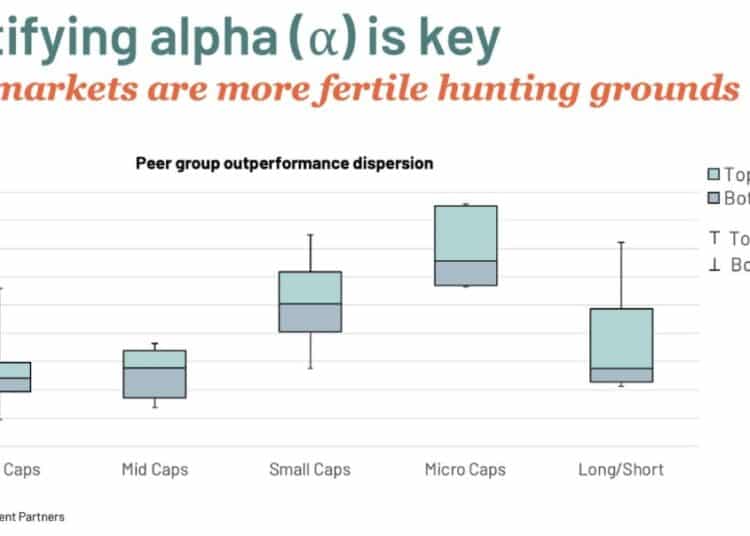
We believe that you can find alpha in all parts of the market, but we recognise that there are parts where it’s certainly easier to do so and where historically it’s been possible to deliver far greater alpha.

For instance, while some might avoid small caps and micro caps because these are more volatile and potentially riskier, as the above chart highlights, active managers in that space have historically been rewarded quite well. The peer group outperformance dispersion is much higher in small and micro caps than large- and mid-caps. 

X

And from our perspective, it is that outperformance that outweighs the potential risk and volatility, especially when it is included as part of a well-diversified portfolio. 

Diversification not de-worsification

While no one can forecast market returns with certainty, what you can do is build an investment portfolio that is risk aware and provides exposure to multiple sources of uncorrelated return drivers. 

When it comes to managed accounts, this involves diversifying both your growth and defensive asset allocations and not, for example, viewing fixed income as one homogenous asset class. Today, there’s a whole gamut of investments that fall into fixed income that are very different from government bonds. Obviously, corporate credit will have a higher risk return profile than government or semi-government bonds, but that doesn’t mean there isn’t a place for it in your defensive allocation in your managed account. 

Too often, people get caught up in the short term. Portfolios will always move around in the short term, like we’ve just seen in January, but you need to keep your eye on the longer-term prize and not be too swayed by short-term moves.

Steven Tang, head of consulting at Zenith Investment Partners.

Related Posts

From artificial to sustainable intelligence: The global energy challenge

by Velika Talyarkhan
December 1, 2025

The promise of AI can only be realised if the world learns to expand this technology without exceeding the limits...

Why dividend growth investing has staying power

by Tom Huber
December 1, 2025

Popular US large‑cap core and growth indexes have become more top heavy and skewed toward high‑growth stocks. So have the...

Debt crisis

Investor discipline necessary as government intervention rises and debt soars

by Hugh Selby Smith
December 1, 2025

Government intervention and mounting debt are reshaping the global economy, forcing investors to adapt to a new era where prudence,...

Leave a Reply Cancel reply

Your email address will not be published. Required fields are marked *

VIEW ALL
Promoted Content

Why U.S. middle market private credit is a powerful income solution for Australian institutional investors

In today’s investment landscape, middle market direct lending, a key segment of private credit, has emerged as an attractive option...

by Tim Warrick
December 2, 2025
Promoted Content

Is Your SMSF Missing Out on the Crypto Boom?

Digital assets are the fastest-growing investment in SMSFs. Swyftx's expert team helps you securely and compliantly add crypto to your...

by Swyftx
December 2, 2025
Promoted Content

Global dividends reach US$519 billion, what’s behind the rise?

Global dividends surged to a record US$518.7 billion in Q3 2025, up 6.2% year-on-year, with financials leading the way. The...

by Capital Group
November 18, 2025
Promoted Content

Why smaller can be smarter in private credit

Over the past 15 years, middle market direct lending has grown into one of the most dynamic areas of alternative...

by Tim Warrick, Managing Director of Principal Alternative Credit, Principal Asset Management
November 14, 2025

Join our newsletter

View our privacy policy, collection notice and terms and conditions to understand how we use your personal information.

Latest Podcast

Podcast

Relative Return Insider: GDP rebounds and housing squeeze getting worse

by Adrian Suljanovic
December 5, 2025
After more than two decades, InvestorDaily continues to be an institution that connects and influences Australia’s financial services sector. This influential and integrated media brand connects with leading financial services professionals within superannuation, funds management, financial planning and intermediary distribution through a range of channels, including digital, social, research, broadcast, webcast and events.

Subscribe to our newsletter

View our privacy policy, collection notice and terms and conditions to understand how we use your personal information.

About Us

  • About
  • Advertise
  • Contact
  • Terms & Conditions
  • Privacy Collection Notice
  • Privacy Policy

Popular Topics

  • Markets
  • Appointments
  • Regulation
  • Super
  • Mergers & Acquisitions
  • Tech
  • Promoted Content
  • Analysis

© 2025 All Rights Reserved. All content published on this site is the property of Prime Creative Media. Unauthorised reproduction is prohibited

No Results
View All Results
NEWSLETTER
  • News
  • Markets
  • Regulation
  • Super
  • M&A
  • Tech
  • Appointments
  • Podcast
  • Webcasts
  • Promoted Content
  • Events
  • About
  • Advertise
  • Contact Us

© 2025 All Rights Reserved. All content published on this site is the property of Prime Creative Media. Unauthorised reproduction is prohibited