

X
  • About
  • Advertise
  • Contact
  • Events
Subscribe to our Newsletter
  • News
    • Markets
    • Regulation
    • Super
    • M&A
    • Tech
    • Appointments
  • Podcast
  • Webcasts
  • Video
  • Analysis
  • Promoted Content
No Results
View All Results
  • News
    • Markets
    • Regulation
    • Super
    • M&A
    • Tech
    • Appointments
  • Podcast
  • Webcasts
  • Video
  • Analysis
  • Promoted Content
No Results
View All Results
No Results
View All Results
Home Analysis

How much risk are you taking?

Hazard reduction is an often overlooked part of investing, writes Perpetual’s Vince Pezzullo – but the problem for many investors is knowing how much risk is in their portfolio in the first place.

by Vince Pezzullo
September 19, 2017
in Analysis
Reading Time: 4 mins read
Share on FacebookShare on Twitter

Every year in Australia as we approach the summer months, the Rural Fire Service undertakes a scheduled hazard reduction process known as back-burning.

The principle is straightforward: by clearing bushland of accumulated fuel (kindling) through controlled burning, the Rural Fire Service can help prevent larger, uncontrollable infernos.

X

Markets have a tendency to move between states of fearing the future where people believe there is no justification for being in markets (usually coincides with market bottoms), to believing that risk is easily measured and controlled. At that point the fear of missing out is all encompassing (and correlations with a market top are typically quite high).

There are several measures that we look at to give an indication of attitudes towards risk. One example is the Chicago Board Options Exchange volatility or VIX index, which is a measure of implied volatilities based on a number of S&P 500 index options.

Some market participants believe the VIX index reflects the risk in the market at a point in time. Our view, however, is that it reflects what people believe is the current risk in the market and it becomes self-fulfilling. As markets climb, the VIX index usually falls, as investors believe that risk is falling.

In my opinion, investors should be thinking quite the opposite.

Risk in low volatility stocks are at 20-year highs

We can observe the behaviour of investors by looking at the current valuations that the market is willing to pay to gain access to a company’s future dividends and cash flows.

Below is a chart supplied by Goldman Sachs, which shows the beta (a measure of volatility or systemic risk of a company) for ‘low volatility’ companies.

The systematic risk of ‘Low Vol’ stocks sits at a 20-year high
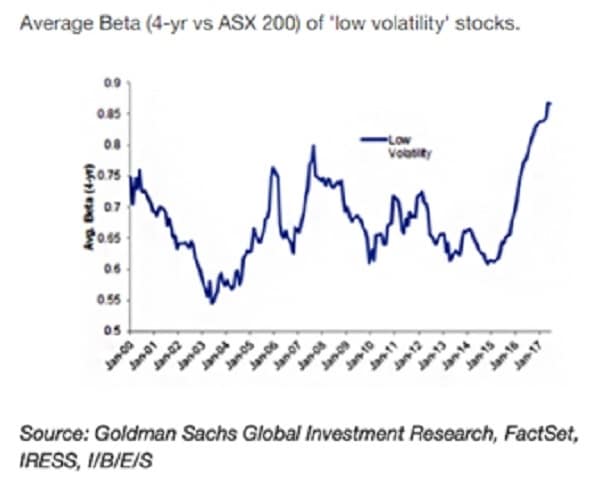
Historically, ‘low volatility‘ stocks have had lower levels of market risk. The chart indicates that the market has pushed up the prices of what are considered ‘low volatility’ stocks.

If you purchase these companies today, you are taking on close to market risk or materially higher risk than has historically been the case.

These companies tend to have low volatility in earnings and cashflow. Due to low interest rates the market has pushed the valuations of these companies up to a point whereby any change to expectations of interest rate changes may lead to a material change in the value of these companies.

Change is in the air

Analysis of the balance sheets of these companies shows that quite a few of them have significant levels of financial leverage. This is in part due to a market environment over the past 10 years where interest rates have been extremely low and real rates have been negative.

As long as interest rates do not rise, these valuations may be justifiable.

However, many central bankers, from the Federal Reserve to the European Central Bank to the Bank of England, have been ‘jawboning’ about unwinding the asset purchases that have occurred over the last 10 years, which will place upward pressure on the long end of the interest rate yield curve.

Even the Reserve Bank of Australia has been talking about a neutral interest rate setting for Australia. That’s likely to be around 3.5 per cent – which is materially above current levels.

Two key takeaways

The adage goes that where there’s smoke there’s usually a fire, and Perpetual’s conservative approach to investing has a proven record of acting as an early warning system for investors.

Firstly, and most importantly, be aware of what price/valuation you are paying to get access to a company’s future cash flows/dividend stream.

Secondly, the valuation that other investors are willing to pay can tell you critical information about the risk appetite of the market. The above example shows that the valuations of ‘low risk/low volatility’ companies have been pushed up to levels whereby investors may be taking on a lot more risk than they think.

Vince Pezzullo is the deputy head of equities and a portfolio manager at Perpetual.

Related Posts

From greenwashing to greenhushing

by Stephen M Liberatore
December 16, 2025

As some US companies embraced "greenhushing" in 2025, global green bond markets kept expanding, showing the importance of careful credit...

Markets look to end the year with momentum

by Patrick Nicoll
December 8, 2025

After a year dominated by political noise, inflation surprises and shifting central bank signals, global markets are closing out 2025...

From artificial to sustainable intelligence: The global energy challenge

by Velika Talyarkhan
December 1, 2025

The promise of AI can only be realised if the world learns to expand this technology without exceeding the limits...

Leave a Reply Cancel reply

Your email address will not be published. Required fields are marked *

VIEW ALL
Promoted Content

Why U.S. middle market private credit is a powerful income solution for Australian institutional investors

In today’s investment landscape, middle market direct lending, a key segment of private credit, has emerged as an attractive option...

by Tim Warrick
December 2, 2025
Promoted Content

Is Your SMSF Missing Out on the Crypto Boom?

Digital assets are the fastest-growing investment in SMSFs. Swyftx's expert team helps you securely and compliantly add crypto to your...

by Swyftx
December 2, 2025
Promoted Content

Global dividends reach US$519 billion, what’s behind the rise?

Global dividends surged to a record US$518.7 billion in Q3 2025, up 6.2% year-on-year, with financials leading the way. The...

by Capital Group
November 18, 2025
Promoted Content

Why smaller can be smarter in private credit

Over the past 15 years, middle market direct lending has grown into one of the most dynamic areas of alternative...

by Tim Warrick, Managing Director of Principal Alternative Credit, Principal Asset Management
November 14, 2025

Join our newsletter

View our privacy policy, collection notice and terms and conditions to understand how we use your personal information.

Latest Podcast

Podcast

Relative Return Insider: MYEFO, US data and a 2025 wrap up

by Staff Writer
December 18, 2025
After more than two decades, InvestorDaily continues to be an institution that connects and influences Australia’s financial services sector. This influential and integrated media brand connects with leading financial services professionals within superannuation, funds management, financial planning and intermediary distribution through a range of channels, including digital, social, research, broadcast, webcast and events.

Subscribe to our newsletter

View our privacy policy, collection notice and terms and conditions to understand how we use your personal information.

About Us

  • About
  • Advertise
  • Contact
  • Terms & Conditions
  • Privacy Collection Notice
  • Privacy Policy

Popular Topics

  • Markets
  • Appointments
  • Regulation
  • Super
  • Mergers & Acquisitions
  • Tech
  • Promoted Content
  • Analysis

© 2025 All Rights Reserved. All content published on this site is the property of Prime Creative Media. Unauthorised reproduction is prohibited

No Results
View All Results
NEWSLETTER
  • News
  • Markets
  • Regulation
  • Super
  • M&A
  • Tech
  • Appointments
  • Podcast
  • Webcasts
  • Promoted Content
  • Events
  • About
  • Advertise
  • Contact Us

© 2025 All Rights Reserved. All content published on this site is the property of Prime Creative Media. Unauthorised reproduction is prohibited