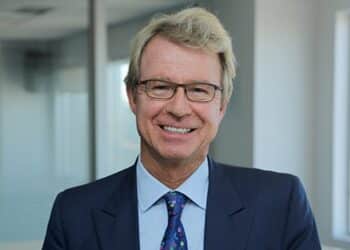

Boutique manager Ten Cap co-founder Jason Todd is cautioning 2026 could see a 10 per cent market correction driven by central bank actions.
Facing a volatile global economy marked by lingering tariff risks and growing imbalances from artificial intelligence (AI) and tech, Ten Cap founder and CEO Jason Todd said he expects 2026 to be a “solid year” much like 2025 has been.
Overall, Todd said the boutique manager remains optimistic, expecting economic growth to consolidate around trend before accelerating in late 2026 and early 2027 as early-year drags ease.
At the same time, he acknowledged that he still expects at least a 10 per cent market correction.
“I suspect that there will again be a correction, probably deep, but short lived,” Todd stated.
However, he said a correction would be far more likely to stem from routine disappointments – the kind markets are currently highly sensitive to – rather than from the bursting of an AI bubble or systemic risks like private credit concerns.
“It’s likely to come from what we suspect is a policy mistake or over-expectation on what the Fed [US Federal Reserve] may do,” Todd explained.
He added that at the same time, today’s cyclical and structural tailwinds look strong and durable enough to keep pushing markets higher. Global equities have surged to record highs this year, powered by AI-driven gains and shifting expectations around US rate cuts.
Todd’s outlook echoes Goldman Sachs CEO David Solomon, who told the Global Financial Leaders’ Investment Summit in Hong Kong last month that a 10 to 20 per cent equity market pullback in the next 12 to 24 months is likely – and a normal feature of bull markets.
The view also came on the back of the International Monetary Fund’s (IMF) warning of a possible sharp correction.
On the other hand, Todd’s Ten Cap co-founder and portfolio manager Jun Bei Liu was unconvinced a correction of more than 10 per cent is likely next year.
While she acknowledged that pullbacks are a normal part of the market cycle – typically 5 per cent every 12 months, 10 per cent every 18 months, and deeper every three years – she said that, overall, conditions still look solid.
A little wobbly but generally positive
Looking more generally at 2026, Todd argued that fears of an AI bubble are overblown, and AI-driven capital spending will keep reshaping global growth.
“At this stage, we see no accelerants that would turn selected weakness into systemic concerns for the US or the global economy,
“Continued investment in AI and technology will boost corporate capital expenditure, offsetting weaknesses in the US labour market and supporting global expansion,” he said.
Todd compared worries over AI spending to last year’s trade uncertainty, noting it neither triggered higher inflation nor a supply shock, nor diminished growth expectations. At the same time, he said markets would experience an uneven recovery, rather than a synchronised boom.
“We expect advanced economies to slow, and emerging markets to see minor upside. But the recovery will be uneven and regionally divergent,” he said.
Highlighting China specifically, he said that unlike many market participants, he doesn’t expect disappointment, but neither does he see policy support driving significantly higher sequential growth.
He added that although much of the easing cycle has already occurred, central banks in the US, Europe, and the UK are still likely to deliver modest rate cuts, while Japan’s normalisation will remain gradual.
Liu said she expects equity markets to surprise to the upside, suspecting they will again be led by the US, where the rally will continue to broaden out with high quality tech and growth stocks remaining supportive off the back of a strong earnings outlook.
“We do not think the year will be characterised by the need to be overly defensive or to favour large liquid stocks over small and mid-cap cyclicals,” she said.
For her part, she argued that a solid economic backdrop, slightly lower policy rates, a recovering consumer, structural themes, and strong liquidity conditions all support continued risk-taking in investing – offset only by valuation concerns.
This contrasts with some other views, including the Future Fund’s recent position paper, which outlined a shift toward prioritising portfolio resilience amid rising inflation and ongoing geopolitical tensions. The fund signalled a preference for defensive assets such as gold and actively managed funds.
For Australian equities specifically, Liu said she expects the market to outshine dull expectations again.