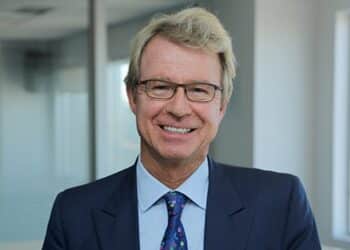

With AI-driven valuations losing momentum and market volatility returning to global equities, US-based quantitative manager Qtron argues that the next frontier of outperformance will be won by understanding people – not machines.
While visiting Australia recently, Qtron co-founder Dmitri Kantsyrev and senior analyst Dr Pedro Solti told InvestorDaily that investors are entering a new cycle in which traditional quantitative edges are being eroded by crowded models and AI-inflated signals.
Qtron recently announced a partnership with Apostle Funds Management to deliver Australian investors access to its wholesale and institutional global equity funds. It describes itself as combining data-driven models with human insight to deliver outperformance.
Solti says there are effectively two separate economies operating right now.
“You have the AI economy … I don’t mean only AI specific firms, I mean everything that’s related to AI – so energy, a lot of times move with AI because they have to be able with data centres, they have to power these data centres … there’s a lot of companies in this AI ecosystem and this economy is behaving very different from the non-AI economy, the way that the factor performance works, the way that investors are willing to take risk and not take risk.”
“This is the biggest thing that we’ve observed from the data right now, how there’s a discrepancy between these two ecosystems in the global space.”
Kantsyrev added this discrepancy brings volatility to the market.
“What we are looking at as investors, as systematic model builders, is to neutralise risks and pick the best stocks in AI, in traditional sectors and consumer discretionaries and so on.
“The models are indifferent by the moves and those sectors, looking to pick the best promising stocks in each of those groups.”
The firm believes that decoding human behavioural biases – from analysts to corporate decision-makers – now offers the most durable alpha.
One of the strongest predictors of stock outperformance, according to Qtron, comes from analysing which types of funds are actively buying or reducing exposure. Only a subset of institutional investors consistently display forward-looking skill, and Qtron says those “smarter cohorts” are now selectively rotating out of overcrowded AI winners.
“What differentiates our approach to most is that we are really stockpickers instead of group pickers,” Solti said.
“For any group of stocks, say Australian material stocks, or India pharma, American AI stocks. In each group, we overweight the best stocks and we underweight the worst stocks. We don’t take a large position of underweighting a country. We don’t take a large position of underweighting a sector. For each country, each sector, each group of stocks are similar looking stocks. We are always overweighting the best, underweighting the worst.”
Qtron’s latest research highlights how companies that look similar at face value can diverge dramatically once revenue geography is factored in. Two Australian firms with parallel business models, for example, can trade in opposite directions depending on whether their earnings lean more heavily toward the US, where demand remains resilient, or China, where growth uncertainties persist.
“We’re moving beyond factor labels to understand where companies truly make their money,” Solti said.
The firm is also quantifying structural optimism among equity analysts. Qtron tracks systematic overconfidence – such as overly aggressive earnings projections – as an early warning for future price corrections.
“Analysts tend to be optimistic in consistent, measurable ways,” Solti said. “That bias becomes a contrarian signal.”
Despite the powerful rally in AI-linked stocks, Qtron says its models resisted the temptation to overweight the theme. The data now points to fatigue within the trade, reflected in slowing estimate revisions and diminishing incremental returns from AI-associated announcements.
“As a result of a portfolio more diversified, we utilise the risk like AI .. is it going up, is it going down? [There’s] a lot of talk about AI bubbles but we look at our portfolios a little more indifferently .. whether its gold or AI, or materials in Australia or banks in Australia or Japan financials,” Kantsyrev said.
“So we pick the best stock in each group. And as a result bring more consistency and less industry and country risk.”
Qtron’s approach is unique, he said, and he believes larger companies cannot do the same.
“When firms are too large, larger than US$3 billion dollars in emerging markets and US$20 billion in developed markets, you’re unable to do that strategy because of liquidity issues,” Kantsyrev said.
“You cannot overweight the best Filipino stock, underweight the worst Indonesian stock. So because of this liquidity difficulty, they have to pick themes. They have to overweight Indonesia as a whole, underweight pharma as a whole. That brings a risk, which is the risk of those themes not working. They’re not being correct on the prediction of themes. It’s a different game they’re playing.”
Qtron recently entered the Australian market through a partnership with Apostle Funds Management, making its global equity strategies available to local investors for the first time.
Apostle said it addresses a gap in the market for quantitative strategies, by combining a disciplined quantitative approach with active research to ensure portfolios remain adaptive and consistently alpha seeking.
“In their investment process, Qtron astutely identifies unique opportunities through diversified, idiosyncratic factor exposures at the stock level, rather than relying on broad sector or country bets. Its strong research culture and team-based process underpin resilient portfolios designed to perform across market cycles, offering Australian investors a differentiated source of potential alpha,” Apostle’s managing director Mitchell Gunman said.
Kantsyrev and Solti say the move comes at a moment when quant investors must evolve.
“The next era of quant won’t be about who has the biggest GPU cluster,” Kantsyrev said. “It will be about who understands human behaviour the best.
“Given this new world of so much quantifiable information, we believe that quants are entering this era where we have an edge over the fundamentals because of the ability of processing so many different ideas at the same time.”
As a result, Qtron says it allows the firm to build a portfolio which is less vulnerable to volatilities on the market. “That allows us to have a portfolio which brings more consistent returns to quant,” Kantsyrev said.