

X
  • About
  • Advertise
  • Contact
Subscribe to our Newsletter
  • News
  • Markets
  • Regulation
  • Super
  • M&A
  • Tech
  • Appointments
  • Podcast
  • Webcasts
  • Promoted Content
  • Events
    • Super Fund of the Year Awards
    • Australian Wealth Management Summit
    • Australian Wealth Management Awards
    • Fund Manager of the Year Awards
    • Adviser Innovation Summit
    • ifa Excellence Awards
No Results
View All Results
  • News
  • Markets
  • Regulation
  • Super
  • M&A
  • Tech
  • Appointments
  • Podcast
  • Webcasts
  • Promoted Content
  • Events
    • Super Fund of the Year Awards
    • Australian Wealth Management Summit
    • Australian Wealth Management Awards
    • Fund Manager of the Year Awards
    • Adviser Innovation Summit
    • ifa Excellence Awards
No Results
View All Results
No Results
View All Results
Home Analysis

Euphoria and reality in European stocks

Investors should take a pragmatic approach to European stocks in the wake of the European Central Bank's (ECB’s) quantitative easing (QE) program, says AB’s Michele Patri.

by Michele Patri
April 21, 2015
in Analysis
Reading Time: 4 mins read
Share on FacebookShare on Twitter

In our view, investors should take a pragmatic approach that aims to capture the gains – but with eyes wide open to reality.

The US, the UK and Japan all witnessed sharp equity market rallies when they launched quantitative easing programs.

The exact same thing has happened in the euro area. The Euro Stoxx 600 Index is up by well over 15 per cent since the start of the year in euro terms as the central bank ushered in ECB-style QE.

But is it sustainable? Given the euro area’s lacklustre growth, deflationary pressures and vulnerability to periodic political and economic crises, investors must be vigilant.

In our view, there are reasons to be cautiously optimistic about the long-term outlook for select euro-area equities.

However, the speed and the extent of the recent rebound mean that it’s prudent to balance a strategic position with tactical short-term defence mechanisms.

Cheaper oil, easy money and a weaker euro

The ECB implemented QE to combat deflation and encourage economic growth. Regional growth dynamics are improving (see graph below) and big-picture political and macroeconomic risks are receding, given policymakers’ clear commitment to ensuring that Europe’s currency union survives.
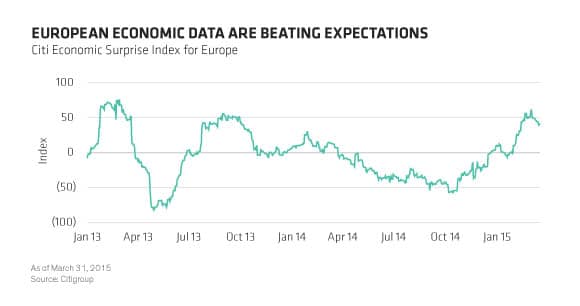
Moreover, European businesses look set to benefit from the healthy convergence of several cyclical tailwinds in coming months.

In euro terms, oil is currently about 30 per cent below its average price in the first half of 2014.

This is a boon for many euro-area businesses, which should see their profit margins rise as their costs fall.

Key beneficiaries include not just transport-oriented businesses, but also other high-energy users, like the steel industry and food producers.

At the same time, consumer-facing businesses could see stronger demand for their goods and services when consumers have more money in their pockets because of cheaper oil.

The ECB’s provision of easy money as part of its QE program is a further big positive.

This should allow euro-area corporates to borrow money very cheaply via banks or directly in capital markets.

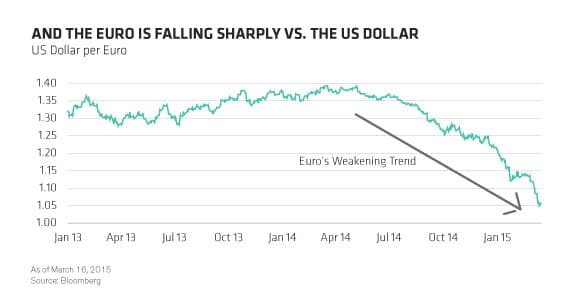
In addition, QE is leading to a weaker euro currency (see graph below), which makes euro-area exports more competitively priced in global markets, while also boosting the value of revenues earned overseas when they’re translated back into euros.

This is significant because euro-area exports account for a big share (around 44 per cent) of the region’s GDP, more than in either the US or Japan.

A weaker euro also helps domestically-focused businesses, whose prices look increasingly attractive as imports become more expensive.
 

So, plenty of positives are starting to feed through. But the question is whether these should be so fully priced into euro-area stocks today.

X

Valuations in parts of the market are looking pretty stretched given that aggregate earnings remain depressed by historical standards.

Some cyclical stocks have seen their earnings bounce, but this seems largely attributable to currency gains – as opposed to a big upturn in demand.

Better safe than sorry?

Euro-area equities may no longer be cheap. But we believe they still look relatively attractive when compared with regional sovereign bonds, which increasingly offer zero or negative yields.

In this environment, it’s worth being a participant in European equity markets – even if short-term volatility is likely.

But it’s also sensible to put strategies in place that seek to minimise any potential equity market drawdowns – particularly given the extent to which regional stocks seem to be pricing in future earnings growth.

So what kind of strategies might afford good protection against potential equity market upsets down the line?

One approach might be to offset exposure to cyclicals that should benefit from better economic conditions with more defensive stocks whose earnings should hold up even when times get tough.

However, this kind of balance is hard to achieve right now because intense investor appetite for stocks offering attractive free cash-flow and dividend yields has left the valuations of many high-quality “bond proxy” stocks in traditionally defensive sectors looking punchy.

Instead, consider a more nuanced approach that taps into a variety of different investing themes and drivers.

When combined with beta hedging overlays, investors can enjoy protection from potential damage when equity markets fall, while benefiting from the euphoria while it lasts.

Michele Patri is a portfolio manager for AB’s European Flexible Equity product.

Related Posts

Bond investors likely to see a steepening curve in 2026

by Karen Manna
January 12, 2026

A clearer policy outlook in 2026 is pushing fixed-income investors back to fundamentals, with expectations of lower rates, a steeper...

ABS vs. private credit: why ABS may offer a better alternative

by Joyce Huang
January 12, 2026

While private credit is drawing strong interest, publicly traded asset-backed securities may offer a more compelling alternative, combining higher income...

From greenwashing to greenhushing

by Stephen M Liberatore
December 16, 2025

As some US companies embraced "greenhushing" in 2025, global green bond markets kept expanding, showing the importance of careful credit...

Leave a Reply Cancel reply

Your email address will not be published. Required fields are marked *

VIEW ALL
Promoted Content

Why U.S. middle market private credit is a powerful income solution for Australian institutional investors

In today’s investment landscape, middle market direct lending, a key segment of private credit, has emerged as an attractive option...

by Tim Warrick
December 2, 2025
Promoted Content

Is Your SMSF Missing Out on the Crypto Boom?

Digital assets are the fastest-growing investment in SMSFs. Swyftx's expert team helps you securely and compliantly add crypto to your...

by Swyftx
December 2, 2025
Promoted Content

Global dividends reach US$519 billion, what’s behind the rise?

Global dividends surged to a record US$518.7 billion in Q3 2025, up 6.2% year-on-year, with financials leading the way. The...

by Capital Group
November 18, 2025
Promoted Content

Why smaller can be smarter in private credit

Over the past 15 years, middle market direct lending has grown into one of the most dynamic areas of alternative...

by Tim Warrick, Managing Director of Principal Alternative Credit, Principal Asset Management
November 14, 2025

Join our newsletter

View our privacy policy, collection notice and terms and conditions to understand how we use your personal information.

Latest Podcast

Podcast

Relative Return Insider: Navigating a volatile 2026 market outlook

by Keith Ford
January 15, 2026
After more than two decades, InvestorDaily continues to be an institution that connects and influences Australia’s financial services sector. This influential and integrated media brand connects with leading financial services professionals within superannuation, funds management, financial planning and intermediary distribution through a range of channels, including digital, social, research, broadcast, webcast and events.

Subscribe to our newsletter

View our privacy policy, collection notice and terms and conditions to understand how we use your personal information.

About Us

  • About
  • Advertise
  • Contact
  • Terms & Conditions
  • Privacy Collection Notice
  • Privacy Policy

Popular Topics

  • Markets
  • Appointments
  • Regulation
  • Super
  • Mergers & Acquisitions
  • Tech
  • Promoted Content
  • Analysis

© 2026 All Rights Reserved. All content published on this site is the property of Prime Creative Media. Unauthorised reproduction is prohibited

No Results
View All Results
NEWSLETTER
  • News
  • Markets
  • Regulation
  • Super
  • M&A
  • Tech
  • Appointments
  • Podcast
  • Webcasts
  • Promoted Content
  • Events
    • Super Fund of the Year Awards
    • Australian Wealth Management Summit
    • Australian Wealth Management Awards
    • Fund Manager of the Year Awards
    • Adviser Innovation Summit
    • ifa Excellence Awards
  • About
  • Advertise
  • Contact Us

© 2026 All Rights Reserved. All content published on this site is the property of Prime Creative Media. Unauthorised reproduction is prohibited